

Much has been written about the supposed death of the value and size premiums. The narrative has become familiar: value has underperformed for more than a decade, small caps have disappointed, and structural changes in markets have rendered traditional factors obsolete.
The problem with this story is simple—it is not consistent with the data.
Consider the period beginning in October 2020, which marked a widely recognized inflection point following the COVID-driven growth surge. From October 2020 through March 2026, the Fama-French U.S. small value index returned 19.7% annually. Over the same period, the total U.S. market delivered 13.8%. Dimensional’s U.S. Small Value Fund (DFSVX) returned 19.8%, an outperformance of 6% over a benchmark without any expenses. Vanguard’s VTSMX returned 13.7%. That is not just outperformance—it is a substantial premium of 6% per year. (Note: Bridgeway’s Omni Small Value Fund BOSVX, which has greater exposure to the size and value factors than does DFSVX, returned an even higher 20.5% per annum, as did Avantis’s US Small Cap Value ETF AVUV which returned 20.8%)
The same pattern appears in international markets. From October 2020 through April 2026, Dimensional’s International Small Value index returned 19.1% annually, compared to 12.9% for the broader international market. Again, a premium of roughly 6% per year. Comparing live funds, Dimensional’s DISVX returned 18.8% versus the 13.2% return of Vanguard’s Developed Markets Fund. That’s an outperformance of 5.6% per annum. (Avantis’s International Small Cap Value ETF AVDV, which has greater exposure to the size and value factors than does DISVX returned and even higher 19.4% per annum).
These are not marginal differences. They are economically large, persistent, and—perhaps most strikingly—largely ignored.
The Narrative Lag Problem
Why has this gone virtually unnoticed?
One explanation is that financial narratives tend to lag reality. The “death of value” story was born during a historically unusual period—roughly 2014 through 2020—when growth stocks dramatically outperformed. That decade coincided with falling interest rates, the rise of intangible-heavy firms, and increasing market concentration.
But investors often make a critical mistake: they extrapolate recent history indefinitely. When a premium underperforms for an extended period, it is declared dead. When it rebounds, the shift is often dismissed as temporary or overlooked entirely.
Premiums Do Not Move in Straight Lines
Factor premiums are not constants; they are long-term expectations that can experience extended cycles of under- and outperformance. The value premium, in particular, has historically been episodic, with large portions of its excess return arriving in relatively short bursts.
The period since late 2020 is a textbook example. Following a decade of underperformance, value—and especially small value—experienced a sharp and sustained rebound. Importantly, this rebound has not been a brief snapback; it has persisted for more than five years.
This persistence challenges the idea that the premiums are structurally impaired.
If Premiums Are “Dead,” Why Are They Elevated?
This raises an obvious question: if value and size premiums are supposed to be shrinking—or disappearing altogether—why have they recently been higher than their historical averages?
There are several plausible explanations:
First, risk-based explanations remain intact. Small value stocks are still riskier—they are more sensitive to economic cycles, have less stable earnings, and often face tighter financing conditions. When investors demand compensation for bearing these risks, premiums emerge.
Second, behavioral explanations have not gone away. Investors continue to chase past winners, overpay for growth, and underweight less glamorous segments of the market. These biases can lead to mispricing that disciplined strategies exploit.
Third, the very narrative of “death” may have reinforced the opportunity. As capital flowed away from value and small caps during the 2014–2020 period, valuations became more attractive as the spread in valuations between growth and value stocks widened to near the 100% percentile. The chart below is from an article I wrote in early 2023 for Alpha Architect.
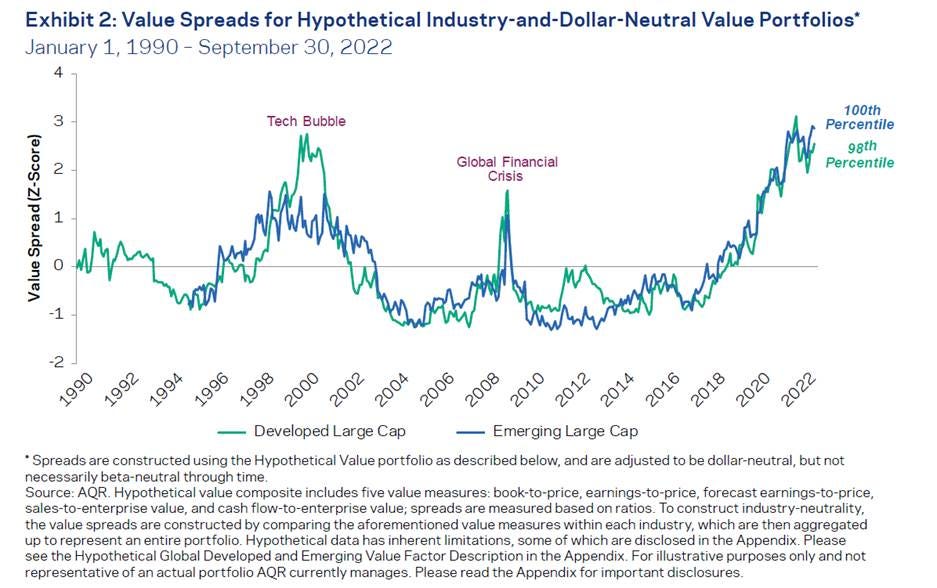
Just as valuations are the best predictor we have of the equity risk premium, valuation spreads are the best predictor we have of factor premiums. Thus, the widening of the spread in valuations set the stage for higher subsequent returns.
The Real Lesson for Investors