
Why Smart Investors Choose Not to Play, The Case Against Active Management
The Golf Tournament You Should Skip

Imagine a wizard grants you a remarkable gift: You become the 11th best golfer in the world. You’re invited to the Super Legends of Golf Tournament, competing against the top 10 players. But there’s a twist that transforms this into an advantage.
Here’s how it works: Each of the 10 best players completes a hole without anyone watching. After they finish, you see all their scores and then decide whether to play the hole yourself or simply accept par as your score.
The first hole is a par 4. The results come in:
Eight players shot bogeys (scored 5)
One player shot par (scored 4)
One player shot a birdie (scored 3)
Now you must decide: play the hole or accept par?
The prudent choice is clear: Take par and walk away.
Why? Because only 10% of the world’s best golfers beat par, while 80% failed to match it. By accepting par without playing, you’ve already outperformed 80% of the elite. Unless you have a specific advantage—like better weather conditions—attempting to beat par is imprudent when even the best players fail 90% of the time.
What This Has to Do With Your Investment Portfolio
This same logic applies directly to active investing. If anyone could consistently beat the market, surely it would be the massive institutional consulting firms advising pension plans and university endowments. These firms command extraordinary resources that individual investors can only dream of.
Consider SEI: A Case Study in Institutional Advantage
SEI is one of the world’s leading investment consultants, advising on more than $1 trillion and managing over $500 billion. Their pitch is compelling:
Access and Expertise
Exclusive access to world-class institutional and boutique managers unavailable to retail investors.
A team of approximately 100 analysts worldwide analyzing the entire universe of investment products.
Sophisticated Selection Process
Quantitative and qualitative research identifying managers with sustainable competitive advantages.
Proactive removal of managers before poor performance emerges.
Continuous monitoring of each manager’s philosophy, process, people, and performance using sophisticated technology
Comprehensive Services
Open architecture providing manager research, selection, and monitoring.
Portfolio construction and scenario modeling.
Customized asset allocation plans addressing specific risk-return requirements.
It’s safe to assume that:
SEI has never hired a manager without a track record of outperforming (or at least matching) their benchmarks.
Every manager made a compelling presentation explaining their past success and future strategy.
The due diligence was thorough and convincing.
The Uncomfortable Truth: The Performance Record
Despite these overwhelming advantages, here’s how SEI’s actively managed funds performed against their benchmarks:
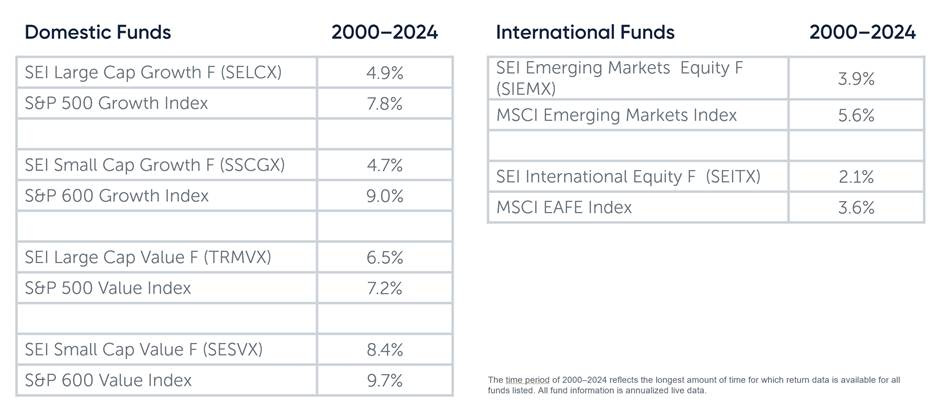
Not a single SEI fund outperformed its appropriate benchmark. More than $500 billion remains invested in what the data clearly shows to be a losing proposition.
The Statistical Reality of Active Management
Eugene Fama and Kenneth French’s 2010 study “Luck versus Skill in the Cross-Section of Mutual Fund Returns“ revealed a sobering finding: only managers in the 98th and 99th percentiles showed evidence of statistically significant skill. That’s a 2% success rate—less than we would expect from random chance alone. And that’s before accounting for taxes, which further erode returns of active funds.
Just as it would be imprudent to try beating par when 90% of the world’s best golfers failed, it’s imprudent to expect investment success when institutional investors—with far greater resources than individual investors or their advisors—fail with remarkable consistency.
Do You Have an Edge?
The only rational reason to pursue active management would be identifying a strategic advantage over institutional players. Ask yourself honestly:
Do I have more resources than billion-dollar consulting firms?
Do I have more time to research investments than teams of 100 professional analysts?
Am I smarter than institutional investors and their specialized advisors?
If you’re being honest, the answer to all three questions is almost certainly no.
Why Wall Street Wants You to Keep Playing
The financial services industry needs you to play the active management game. They need you to attempt beating par. They know your odds of success are dismally low, but they profit from high management fees regardless of whether you win or lose.
The financial media outlets need you engaged and “tuning in” to generate advertising revenue. They profit from keeping you active and anxious about your investments, constantly searching for the next hot stock or fund manager.
Both industries benefit enormously from convincing you that active management is worth pursuing—even though the evidence overwhelmingly suggests otherwise.
The Alternative: Choosing Par
You have another option. Just as you could choose not to play in the Super Legends of Golf Tournament, you can choose not to play the active management game.
Accept market returns through low-cost, tax efficient “passive” investment vehicles:
Index funds that track market benchmarks.
Systematic, transparent, and replicable (quant-based) investment strategies.
By choosing this approach, you’re virtually guaranteed to outperform the majority of both professional and individual investors. You win by not playing.
This is why active investing is called a “loser’s game.” Not because the participants are losers—many are highly intelligent and well-educated. Not because winning is impossible—a small percentage do succeed. But because the odds of success are so low that attempting to win is imprudent from a financial perspective.
When Active Investing Might Make Sense
There are only two logical reasons to pursue active management:
Entertainment Value: You genuinely enjoy the research, analysis, and excitement of picking stocks or managers. You find it intellectually stimulating.
Bragging Rights: You enjoy the potential to tell others about your investment successes (though notably, we rarely hear about the losses).
If either applies to you, consider this: Prudent gamblers bet only an infinitesimal fraction of their wealth on entertainment. Even if you derive genuine enjoyment from pursuing investment outperformance, you should risk only a tiny portion of your retirement savings, inheritance plans, or charitable intentions on active managers overcoming such unfavorable odds.
The True Purpose of Investing
Active investing can indeed be exciting. But investing was never meant to be exciting—that’s a myth perpetuated by Wall Street and the media. Investing is meant to provide the greatest probability of achieving your financial goals with the least amount of risk necessary.
That’s what distinguishes investing from speculating or gambling.
Your Choice
The data is clear. The odds are unfavorable. The resources required are immense. Most importantly, there’s a better alternative readily available.
The question isn’t whether you can play the active management game. The question is whether you should. And for most investors, the evidence suggests the answer is no.
Choose par. Accept market returns in the asset classes you want exposure to. And let the odds work in your favor instead of against you.
Larry Swedroe is the author or co-author of 18 books on investing, including his latest Enrich Your Future. He is also a consultant to RIAs as an educator on investment strategies.
Great article and it raises valid points about not trying to outcompete professionals. However, how do you reconcille incorporating alternatives into your portfolio with low correlations to the market indices, when most of the options are actively managed (whether from AQR, or other firms)? Investor's are not directly competting with these funds and strategies, but are theorettically getting value by improving their portfolio Sharpe Ratio's or drawdown statistics by adding them to their portfolios. So, does active have a role in a portfolio or better to stay away from their impressive past results?